Condo & Townhome Water Damage in Milpitas, CA
In stacked buildings one leak rarely stays in one unit. The restoration team traces the water up and down, maps every affected unit and keeps the records owners, HOAs and adjusters each need.
(888) 774-9605Get a Milpitas condo leak dried out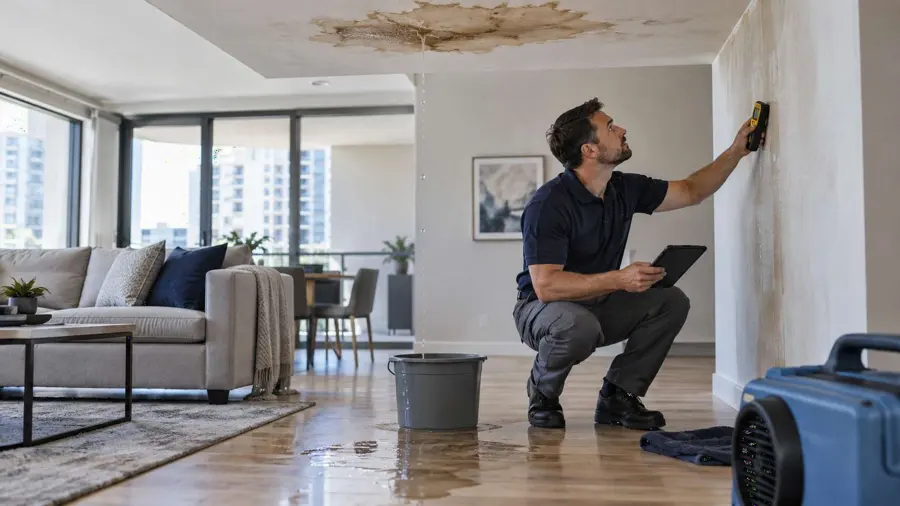
First steps for condo and townhome water damage in Milpitas
- 1Stop the source
Shut the unit valve, the washer valves or the water heater supply.
- 2Tell the neighbor below
Knock and check their ceiling right away.
- 3Call the HOA manager
Report common-area pipes or sprinkler heads.
- 4Photograph both units
Record wet ceilings, floors and the failed part.
- 5Call for extraction
Every affected unit gets checked and mapped.
What does condo and townhome water damage cost in Milpitas, CA?
In Milpitas, CA, condo and townhome water damage typically runs $900 to $15,000 or more across the affected units, depending on how many units the water reached, the category of water, the material class and how quickly drying started.
| Loss size | Typical range | What usually drives it |
|---|---|---|
| One unit, one room | $900 to $2,800 | Clean water, no unit below, air movers and readings |
| Source unit plus one below | $2,800 to $6,500 | Ceiling cavity drying, two moisture logs, LGR dehumidifiers |
| Three or more units | $6,500 to $15,000+ | Stacked bathrooms, sprinkler or riser leak, material removal |
Ranges only, never a quote. The category of water, the square footage, the material class and how fast drying started move the number most. The water damage cost calculator gives a closer planning range.
How condo and townhome water damage is handled in Milpitas
- 1
Trace
Source unit first, then every unit below and beside it.
- 2
Extract
Standing water comes out of each affected unit.
- 3
Dry between levels
Ceiling cavities and floor systems dried with air and LGR units.
- 4
Document per unit
Separate logs and photos for owners, HOA and adjusters.
Milpitas has more stacked housing than most South Bay suburbs. There are 1980s and 1990s condo complexes off Jacklin Road and Calaveras Boulevard, and the Transit Area around the Great Mall and Milpitas BART added thousands of three- and four-story townhomes and podium condos in the 2010s and 2020s. Upstairs laundry closets, stacked bathrooms and water heaters in garages or closets mean a single failure can reach two or three homes.
How unit-to-unit leaks are traced
Water moves down and sideways through floor assemblies, along joists and inside shared walls. The tech who does the walkthrough starts at the source unit and checks every unit below and beside it with thermal imaging and meters, including ceilings, the tops of walls and the floor system between levels.
- Upper-floor washer boxes and drain hoses
- Toilet supply lines and wax ring failures in stacked bathrooms
- Water heaters and tankless units in closets and garages
- Shower pans and tub overflows that leak into the ceiling below
- Fire sprinkler heads and lines in newer podium buildings
Drying a townhome or condo without guesswork
The extraction crew removes standing water in every affected unit. The drying team then dries the ceiling cavity and floor system between levels, which is where water hides in townhomes. Small openings in ceiling drywall let dry air circulate. LGR dehumidifiers are sized to each unit, and each unit gets its own moisture log.
Separate logs matter because the source unit, the unit below and the association may each have a different insurance policy and a different adjuster. A clear record of what was wet, where and for how long helps every party.
Owners, HOAs and insurance in Milpitas
Responsibility usually depends on the association CC&Rs: some HOAs cover the building structure and common pipes, while owners cover the interior of their unit. Check your governing documents and your own HO-6 policy. The California Department of Insurance has plain-language help on condo coverage, and the City of Milpitas can answer permit questions for any rebuild.
Common condo and townhome layouts in Milpitas
Many Transit Area townhomes stack a garage on the ground floor, living space in the middle and bedrooms with the laundry closet on top. A washer leak on the top floor can therefore wet a bedroom ceiling, a living room wall and the garage ceiling in one event.
Older garden-style condos put units side by side and above one another around courtyards, so leaks travel through shared walls as often as through floors. The tech who does the walkthrough checks both directions.
Covering Milpitas, CA and the east foothills
The Milpitas restoration crew handles condo and townhome water damage across ZIP code 95035 and the neighboring South Bay cities, day or night.
Sunnyhills, the Transit Area, Midtown, Summitpointe, the Jacklin Road neighborhoods and McCarthy Ranch, plus North San Jose, Berryessa and Warm Springs next door.
See every neighborhood and ZIP coveredRelated water damage services in Milpitas
Condo and Townhome Water Damage questions in Milpitas
Who is responsible for a leak from the unit above?
It depends on where the leak started and what the association CC&Rs say. Often the owner of the source unit, the HOA and each insurer share the loss. It is worth checking your governing documents and your own policy.
Why does the unit below need its own moisture check?
Water travels through the floor system and ceiling cavity and can be wet behind a ceiling that looks dry. Measuring each unit is the only way to know what needs drying.
Can the ceiling be dried without replacing it?
Often yes, when the water is clean and drying starts quickly. Ceilings that sag or held dirty water are removed for safety.
How long does drying take in a townhome?
A contained clean-water loss usually dries in three to five days. Losses that reach several levels or run inside shared walls can take longer.
What is an HO-6 policy?
It is the homeowners policy for a condo or townhome unit owner. It usually covers the unit interior and personal property, while the HOA master policy covers the building. Coverage depends on your policy.
What about fire sprinkler leaks?
Sprinkler lines in podium buildings carry a lot of water under pressure. The building manager shuts the zone, and the extraction crew works through every affected unit and corridor.
Condo and Townhome Water Damage in Milpitas? Call now.
The restoration team extracts the water, dries the structure to the IICRC S500 goal and records every reading for the claim file.